Industry
SURPLUS WIRE FROM UTILITIES AND POWER PROJECTS
Utilities buy cable in quantity and retire it on paperwork. A stock room standardizes on one insulation type, one voltage class, one stranding, and when the standard moves the older reels stay on the rack. Line crews return partial reels from a rebuild. Generation sites pull feeders during an outage and cut the tails back. Renewable projects finish a collection system and leave the last few drums in a laydown area. Most of that material is clean, banded and dry, which makes it easy to describe.
Electric Utilities and Power Generation
North DakotaStock room reels that no longer match the standard
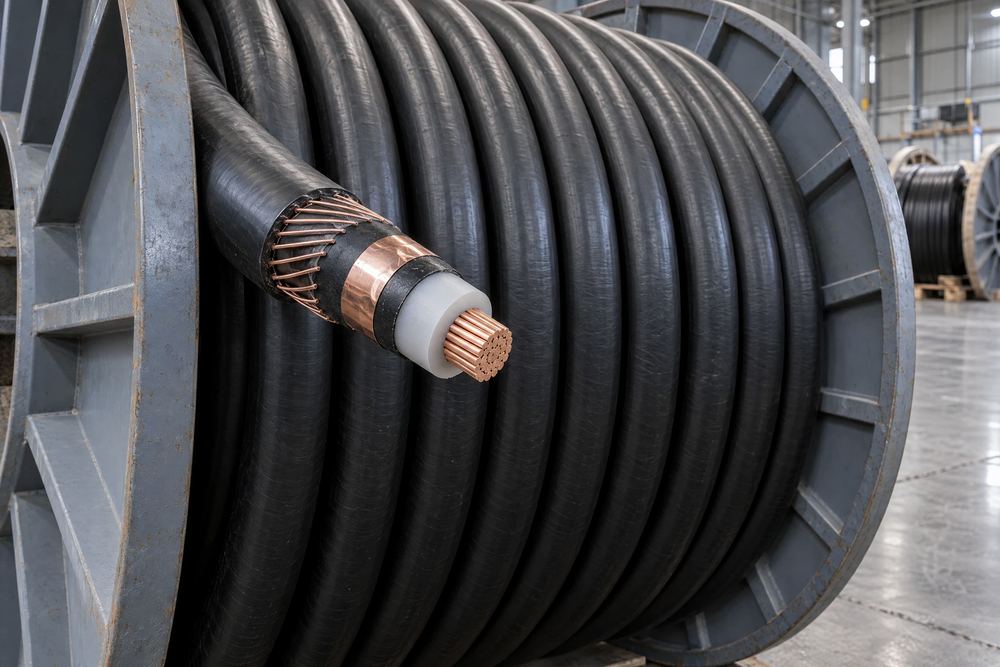
A utility stock room is built around a small number of items bought deep. When the standard changes, the old item does not disappear. It sits on the bottom rack, still banded, still tagged, in lengths from 500 to 2,500 feet. URD and USE-2 in #2 and 1/0, jacketed direct burial, and triplex or quadruplex service cable are common residents of that shelf, often with the distributor label still wired to the flange.
The reel tag usually survives the years. If it does not, the jacket print does: USE-2 or URD, conductor size, voltage rating, whether the neutral is full size. Those details let us ask a sensible question about the material instead of guessing at it. Old stock is not a problem on its own. Old stock with no identification is a slower conversation, because everything then rests on a tape measure and a photograph.
Generation, substation and renewable leftovers
Outage work generates short lengths that still matter. Bare copper grounding conductor in 4/0 and 250, counterpoise run out to a fence, jumpers cut to fit, and the flexible braid that comes off a disconnect. Substation grounding is mostly bare copper, and a partial reel of 4/0 bare is worth photographing whether or not the tag is still readable. Weigh it if the footage is only a guess.
Renewable projects add their own inventory: PV wire from a DC array, 15kV and 25kV EPR concentric neutral feeders, 35kV collection cable, and shielded cable around the collector substation. When a project is complete or a phase is descoped, drums that were never unwrapped stay wrapped. Say whether the factory wrap and the reel banding are still in place, and whether the drums sat inside or out.
Cut ends, weather and how it ships
Cable that lived outdoors shows it. Sun checked jacket, water in an open end, a flattened drum, rusted banding. None of that automatically ends a review, but it belongs in the description. A reel that sat on gravel through two winters should be photographed where it sits, with the tag facing the camera and the flange in frame. A tape measure across the drum answers a surprising number of questions.
Loading is the other half of the job. Reels travel well on a flatbed with the drum chocked and banded, and a utility yard usually has the forklift to set one. If you are shipping instead, an LTL carrier will take a pallet of coils, and the freight class depends on weight and dimension. We arrange the pickup or the shipping once the material and the site access are clear.
Which wire and cable shows up
- URD and USE-2 direct burial cable
- 15kV and 25kV EPR concentric neutral
- 35kV collection cable from wind projects
- Bare copper grounding and counterpoise
- THHN and XHHW in stock lengths
- SER and SEU service entrance cable
- PV wire and DC string cable
- Control, SCADA and shielded cable
How surplus accumulates in this sector
- A stock room retires a voltage class or a jacket type and the shelf stock stays.
- A rebuild leaves partial reels of URD that are too short for the next run.
- An outage closes out with cut tails and jumpers in a conex.
- A renewable phase is descoped and factory wrapped drums never leave the laydown area.
- A contractor overbuys service cable for a subdivision and returns only part of it.
- Substation grounding left over from a project sits in the yard as short lengths.
This is not a customer list. These are potential seller audiences in North Dakota. No facility, contractor or company is described as having surplus inventory, and no relationship or endorsement is implied.
Request a purchase quote
Send the wire details. Get a real conversation.
Photos and a few specs are enough to start. We will come back with questions or pricing, then agree on pickup or shipping.
Clearing a storeroom or a laydown yard?
Send one wide photo of the pile and whatever tags you can read. We will work from there.