Wire category
WE BUY SURPLUS MEDIUM AND HIGH VOLTAGE CABLE
Medium voltage cable is the material that makes a seller nervous and a buyer careful. A reel of 15kV cable is expensive, heavy, and only useful if the insulation system is intact. We buy it from 5kV through 69kV and above, shielded and concentric neutral, on full reels and on cut lengths with a known history. Most of what we see is project surplus that was never energized, which is the easiest kind to review.
Medium and High Voltage Cable · North Dakota
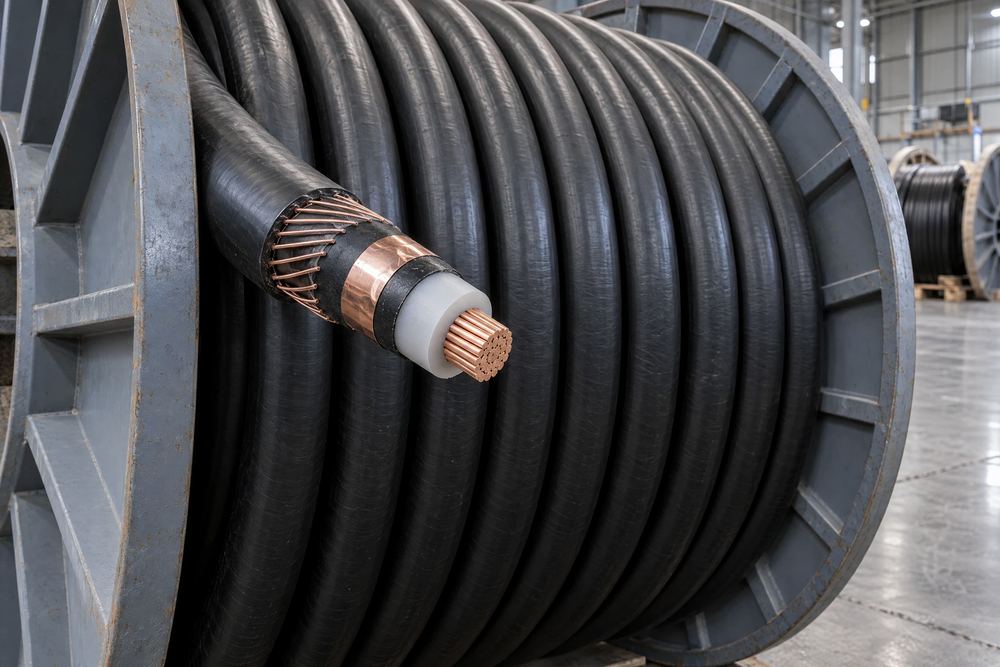
Surplus wire, reviewed from photosThe construction is layered, and each layer does a job: stranded conductor, conductor shield, insulation, insulation shield, metallic shield or concentric neutral, then a jacket. EPR and XLPE are the two insulation compounds you will see, and the print names the voltage class, the insulation level and the temperature rating. A reel with the factory wrap still on the outer layer and the tag wired to the flange answers most questions before anyone measures anything.
What we buy in this category
- 5kV and 8kV shielded cable
- 15kV EPR and XLPE, including TR-XLPE
- 25kV and 35kV cable on full reels
- 46kV and 69kV cable and above
- Concentric neutral and copper tape shielded constructions
- URD cable in 15kV and 25kV
- Cut lengths with known footage and history
- Reels still banded with the factory tag
The layers, and the five photos that matter
Start at the conductor. Compact stranded copper or aluminum, sized in AWG or MCM, sometimes with a moisture blocking strand seal. Then a semi-conducting conductor shield extruded tight against the strands, then the insulation wall, then a semi-conducting insulation shield, then copper tape or concentric neutral wires, then the jacket over all of it. The insulation shield is the layer most often damaged by a careless cut, and it is the layer a buyer looks at first.
A photo of the cut end shows every layer at once. A photo of the jacket print gives the voltage class and the type. A photo of the reel tag gives the footage. A photo of the outer wrap shows whether the reel lived indoors or in the sun. The fifth photo is the whole reel, so the flange condition is visible before anyone talks about loading. If the reel cannot be moved, take the cut end close up and the tag separately.
- Stranded or compact stranded conductor
- Extruded semi-conducting conductor shield
- EPR or XLPE insulation wall
- Semi-conducting insulation shield
- Copper tape shield or concentric neutral wires
- PVC, PE or CPE jacket over the shield
Voltage class, insulation level and temperature
The class is the design voltage of the insulation: 5kV, 8kV, 15kV, 25kV, 35kV, 46kV, 69kV. Within a class the insulation level is stated as 100, 133 or 173 percent, and it corresponds to whether the system is grounded, ungrounded or resistance grounded. Cable built to one level is not a substitute for another at the same nominal voltage. A 15kV reel at 133 percent is a different item than one at 100 percent, even at the same size.
Temperature rating is the other half of the label. MV-90 cable is rated for a 90°C conductor and MV-105 for 105°C, and the ampacity tables differ between them. TR-XLPE, the tree retardant version, is common on utility underground cable. EPR handles heat and flex differently from XLPE, and the two are not swapped casually on a reel that will be energized. Conductor temperature and ambient correction both feed the ampacity table, so the same cable carries different current in duct and in air.
Reels, storage and moving five thousand pounds
Medium voltage cable ships on heavy wooden reels, often 500 or 1000 feet, and a full reel of 15kV three conductor can weigh thousands of pounds. It should be stored upright on the flange, not on its side, and kept out of standing water. A reel that has lain flat in a yard for years has a flattened outer layer and a question mark attached to it. Reels stored on gravel rot at the bottom flange after a few wet seasons, and that changes how they can be moved.
Loading takes equipment, not muscle: forks that span the drum, a sling through the eye if the reel has one, and a trailer deck that takes the point load. Cut lengths are welcome when the footage is known, but history matters more here than anywhere else. Give the drum diameter and the approximate weight if you have them, since that decides between a flatbed and a lowboy. Utility, wind and oilfield work in North Dakota produces reels like this, and two questions are better than a guess.
What to send with your request
- The full jacket print: voltage class, insulation type, MV rating
- The insulation level if it is printed, 100, 133 or 173 percent
- Conductor material, size and stranding
- Shield type: copper tape, concentric neutral or both
- Footage from the reel tag and whether the reel is full
- A photo of the cut end showing every layer
- Photos of the outer wrap, the flanges and any jacket damage
- Whether it is project surplus, pulled and reinstalled, or unknown
Not sure it fits? Send it anyway. If the construction is something else entirely, we will say so and point you at the right category. Condition and partial footage do not disqualify a submission — they just become part of the conversation.
Request a purchase quote
Send the wire details. Get a real conversation.
Photos and a few specs are enough to start. We will come back with questions or pricing, then agree on pickup or shipping.
Common questions
Medium and High Voltage Cable questions
What does the insulation level percentage mean?
It describes the thickness of the insulation relative to the basic impulse level of the system, and it follows whether the neutral is grounded. A 100 percent cable is for a grounded system, 133 percent for ungrounded, and 173 percent for higher stress cases. The print states which one the reel is.
Do you buy cut lengths of 15kV cable?
Yes, when the footage is known and the ends are sealed. History matters with cut lengths, so say whether the cable was pulled and reinstalled or cut from a new reel. A photo of the cut end shows the layers and any moisture tracking.
How should a reel be stored before pickup?
Upright on the flange, blocked so it cannot roll, off the ground if possible, and out of standing water. Keep the jacket and the tag out of direct sun where you can. That is enough to preserve the material until it is loaded.
Reels sitting in the yard?
Send the tag and a photo of the jacket legend. We will tell you what we need to make an offer.