Wire category
WE BUY SURPLUS CONTROL AND INSTRUMENTATION CABLE
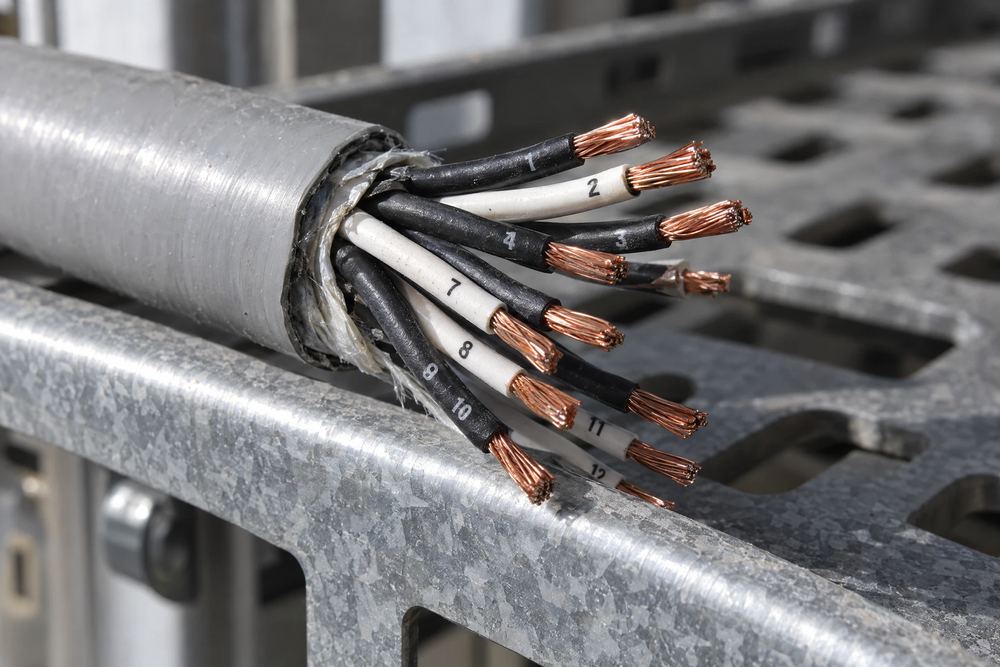
Control cable is bought by the conductor and sold by the foot, and the leftovers rarely go back on the shelf in order. A plant pulls a 19 conductor run, has 14 conductors left on a partial reel, and the tag is long gone. What saves the quote is the jacket print and a photo of the cut end, where the conductor numbers show. Send both and the reel can usually be identified. A drum with the factory wrap still on it and the tag wired to the flange is the easiest to review, but a bare reel with readable print is close behind.
Control and Instrumentation Cable · North Dakota
Surplus wire, reviewed from photosThe family covers a wide range: 600 volt multiconductor control cable in 14 and 16 AWG, 300 volt instrumentation tray cable, shielded pairs and triads for analog signals, and thermocouple extension wire. Jacket color varies by maker, so do not lean on it. The print and the construction identify the cable, and the conductor count at the cut end confirms it. Voltage class is the first split: 600 volt control cable and 300 volt instrumentation are reviewed separately.
What we buy in this category
- 600V multiconductor control cable, 14 and 16 AWG
- TC and ITC rated control and instrument cable
- PLTC cable for power limited circuits
- Shielded pairs and triads with a drain wire
- Thermocouple extension wire in Types J, K, T and E
- Armored control cable with interlocked aluminum
- Numbered conductors from 3 through 37
- Partial reels and shop cut lengths
Conductor count, numbering and shielding
Control cable conductors are numbered or color coded, and the numbers are printed every few inches along the insulation. A 12 conductor cable reads 1 through 12, sometimes with tracers on the odd numbers. The ground, when there is one, is usually green. Count at the cut end and compare with the print, because a tag that says 12 may belong to a different reel after a few moves. Tracers and stripes vary by manufacturer, so the printed numbers are more reliable than the color scheme.
Shielding is either a foil tape with a drain wire or a wire braid. Foil gives full coverage and suits lower frequencies; braid is more rugged and handles flex better. Some constructions shield each pair individually and then add an overall shield, which is what an analog instrument loop wants. Note which one you have, because it is the difference between a signal cable and a control cable. A drain wire cut short at the end makes the shield hard to inspect, so leave an inch or two of it.
- Overall foil shield with a tinned copper drain
- Individual pair shields plus an overall shield
- Braid shield over the conductor assembly
- Unshielded multiconductor for start stop circuits
- Green ground conductor in the same jacket
- Armored construction with an overall PVC jacket
TC, ITC and PLTC are not interchangeable
Control cable can carry a TC rating for 600 volt power and control circuits in tray, an ITC rating for 300 volt instrumentation in tray under Article 727, or a PLTC rating for power limited circuits under Article 725. The same jacket can look identical across all three. The difference is the listing and the voltage, and that decides where the cable may be installed. Put the voltage in your description even when you are sure, because a mislabeled reel wastes a whole review.
Armored versions add an interlocked aluminum or steel armor over the assembly, often under an overall PVC jacket. They are heavier and stiffer, and they are common where a cable leaves a tray and runs down a wall in a plant. Direct burial ratings appear on some instrumentation constructions and not on others, so the print decides rather than the jacket appearance. If the armor is kinked or split, say so, since that is the first thing a buyer looks at.
Pairs, triads and thermocouple extension
Instrumentation cable is built in pairs and triads. A triad carries a three wire RTD signal, while a shielded pair carries a 4 to 20 milliamp loop. Sizes are usually 16 or 18 AWG, with 20 AWG in some signal constructions. Thermocouple extension wire is a separate product, matched to the thermocouple type, with the alloy of each leg doing the work. The three conductors of a triad are usually numbered, which makes the type easy to confirm at the cut end.
That matching matters. Type K extension is not Type J extension, and the jacket or the print will say which. If a reel has lost its marking, the conductor color code is the next clue, and it is worth a photo. None of this is exotic, but it is why a generic description of control cable does not get far. Say what the print says, and say what you do not know. Panel rebuilds and pipeline instrument work in western North Dakota turn over short reels like these. Photos of the jacket print and the conductor numbers usually settle the type in one pass.
What to send with your request
- A photo of the jacket print and the voltage rating
- The conductor count, read at the cut end
- Conductor size, for example 16 AWG
- Whether there is an overall shield, a braid, or both
- The reel tag and the footage
- For thermocouple wire, the type letter and color code
- Whether the reel is armored and what the jacket is
- Full or partial reel, and how it has been stored
Not sure it fits? Send it anyway. If the construction is something else entirely, we will say so and point you at the right category. Condition and partial footage do not disqualify a submission — they just become part of the conversation.
Request a purchase quote
Send the wire details. Get a real conversation.
Photos and a few specs are enough to start. We will come back with questions or pricing, then agree on pickup or shipping.
Common questions
Control and Instrumentation Cable questions
What is the difference between control cable and instrumentation cable?
Control cable switches things and instrumentation cable carries a signal. Control cable is usually 600 volt multiconductor with numbered conductors, while instrumentation cable is often shielded pairs or triads at 300 volts with lower noise pickup.
Can a partial reel with no tag still be identified?
Usually, from the print on the jacket and the numbers on the conductors. A photo of the cut end showing the conductor count plus one clear stretch of print is enough to start the review.
Do you buy thermocouple extension wire?
Yes, in the common types, on reels or in cut lengths. The type letter and the conductor color code are what identify it, so photograph the print and the exposed conductors.
Reels sitting in the yard?
Send the tag and a photo of the jacket legend. We will tell you what we need to make an offer.