Wire category
WE BUY SURPLUS ALUMINUM WIRE AND CABLE
Aluminum wire is the lightest thing on a service rack and the one most often misdescribed. A reel of 500 kcmil aluminum looks like a big reel of copper until you lift it. It is not copper, it is not reviewed like copper, and the alloy and the stranding matter as much as the size does. The flange stencil or the print usually settles it: aluminum reels are marked AL and copper CU.
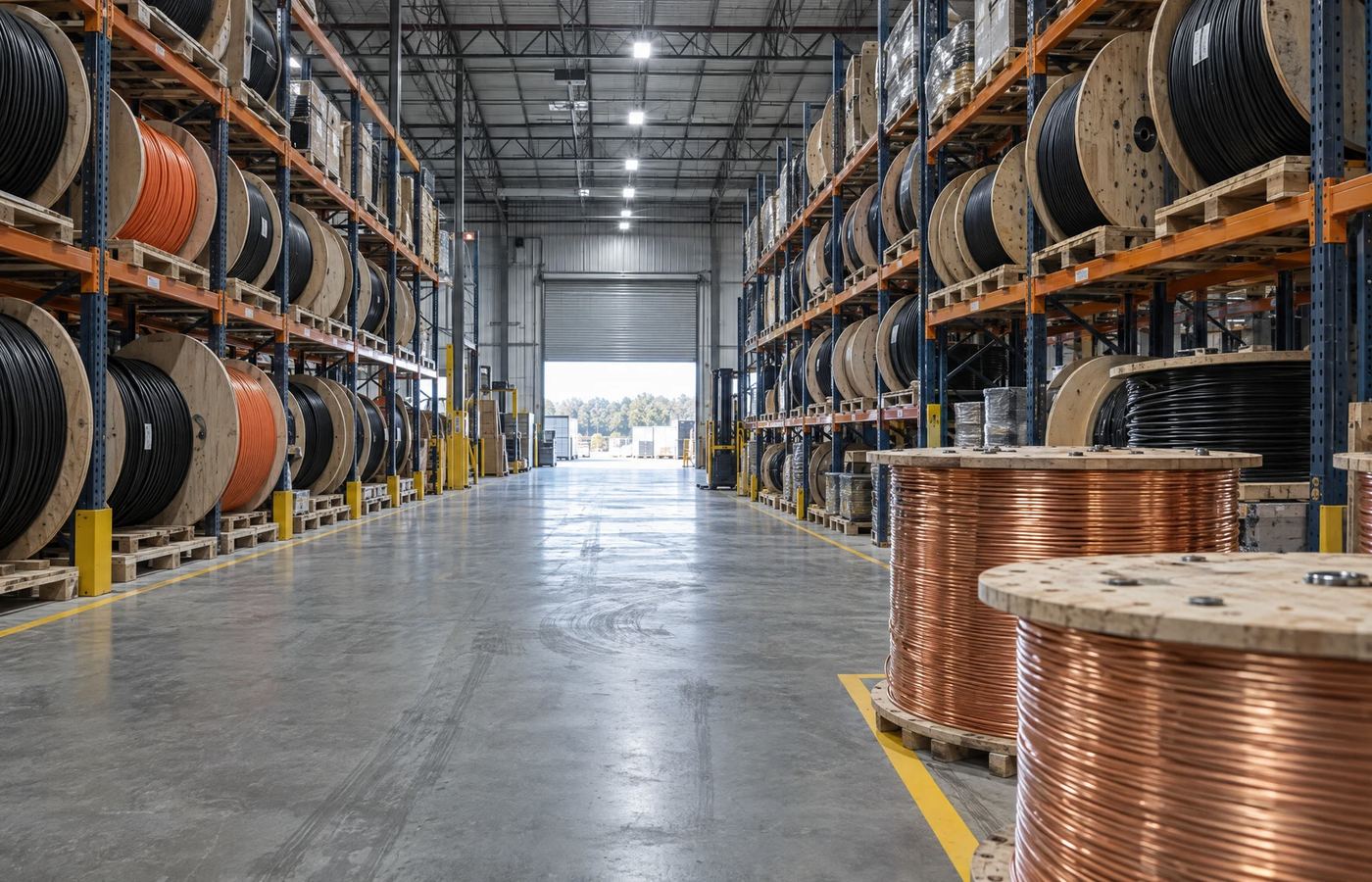
Aluminum Wire and Cable · North Dakota
Surplus wire, reviewed from photosMost building aluminum today is AA-8000 series alloy, compact stranded, made for terminations listed for aluminum. It turns up as XHHW-2 feeders, SEU and SER service cable, URD and USE-2 underground conductor, and overhead line wire. Each of those is a different construction with its own buyer, so name the type rather than just the metal. Ask which construction it is before the size, because a service drop assembly and a 1000 MCM feeder share nothing but the metal.
What we buy in this category
- Aluminum XHHW-2 feeders, 1/0 through 1000 MCM
- SEU and SER service entrance cable
- URD and USE-2 direct burial conductor
- Bare aluminum and ACSR overhead line wire
- Covered overhead conductor on reels
- Aluminum cable in medium voltage constructions
- Compact stranded conduit wire
- Partial reels and random lengths
Alloy, stranding and why the size jumps
Aluminum conducts less than copper, so the same ampacity needs a larger conductor. A 100 amp feeder that would be #3 copper is #1 aluminum. Above 4/0 the sizes move into MCM, also written kcmil, and 250, 300, 350, 400, 500, 600, 750 and 1000 MCM are the common steps. That is why aluminum reels look oversized for the current they carry. The ampacity tables carry aluminum in separate columns from copper, and the gap is visible on paper.
AA-8000 series alloy is the grade used for most building wire, and the print will say so. Compact stranding shrinks the outside diameter and makes the conductor easier to bend and terminate. Older AA-1350 alloy and the solid aluminum branch wire of decades ago are a different situation and should be described honestly, because a buyer will ask which one it is. Solid aluminum branch wire from the 1960s and 1970s is a distinct product with its own history and should be identified as such, not folded into a general lot.
Service cable, URD and overhead
SEU and SER are aluminum service entrance assemblies, with two or three insulated conductors wrapped around a bare or reduced neutral under a gray or black jacket. URD and USE-2 are the underground versions, rated for direct burial and often dual marked. The print on the jacket states the type, the conductor sizes and the temperature rating. SEU carries a bare neutral wrapped around the conductors, while SER uses an insulated neutral with a separate bare ground.
Overhead line wire is its own category: bare aluminum, ACSR with a steel core, and covered versions used by utilities. Those come on large reels, often in random lengths, and the tag carries the size, the strand count and the footage. Utility leftovers are usually well tagged, because the line crews work from the tag rather than from memory. Reel sizes for overhead wire run large, often 2500 feet and up, and those want a trailer with a reel cradle.
- Triplex and quadruplex service drop assemblies
- SEU with a reduced bare neutral
- SER with an insulated neutral
- URD in 15kV and 25kV constructions
- ACSR with a steel reinforced core
- Compact stranded XHHW-2 in 350 through 1000 MCM
Light metal, heavy reels, easy freight
Aluminum weighs roughly a third of what copper does for the same volume, so a reel that looks like a two person lift often is one. That helps on freight and it helps at the dock. It does not help with diameter: a 1000 MCM aluminum reel is wide and awkward and still needs forks that span the drum. For the same conductor size aluminum runs about a third of the copper weight, so a full reel can go where a copper reel of half the footage could not.
Terminations matter to the next user rather than to the review, but they come up. Aluminum needs a connector listed for it, often marked AL9CU when it also takes copper, and oxide inhibitor on the conductor. If the wire was cut and re terminated you will see the marks. If the conductor was cut with a saw rather than a cutter, the strands will be flattened, and that is worth a mention. Utility and grain facility work in North Dakota turns up aluminum feeders and URD in usable lengths.
What to send with your request
- The type from the jacket print: XHHW-2, SER, URD, ACSR
- Size in AWG or MCM, and the conductor count
- Whether the alloy is marked AA-8000
- The reel tag with footage and length
- A photo of the cut end showing the stranding
- Whether the reel is wood or steel
- How the reel is stored and whether it has been rolled
- Loading access and the approximate reel weight
Not sure it fits? Send it anyway. If the construction is something else entirely, we will say so and point you at the right category. Condition and partial footage do not disqualify a submission — they just become part of the conversation.
Request a purchase quote
Send the wire details. Get a real conversation.
Photos and a few specs are enough to start. We will come back with questions or pricing, then agree on pickup or shipping.
Common questions
Aluminum Wire and Cable questions
Is all aluminum wire the same alloy?
No. AA-8000 series is the alloy used for most current building wire, while older AA-1350 and solid aluminum branch wire are different products. The print or the reel tag usually states the alloy, and it changes how the material is reviewed.
Do you buy aluminum service drop assemblies?
Yes, including triplex and quadruplex assemblies, on reels or in cut lengths. Give the conductor sizes and the neutral size if they are printed, because those numbers decide the review.
Why is aluminum handled differently from copper?
It is a different metal with its own market, and it takes more volume for the same current. The review follows the alloy, the construction and the weight rather than a copper comparison.
Reels sitting in the yard?
Send the tag and a photo of the jacket legend. We will tell you what we need to make an offer.