Wire category
WE BUY SURPLUS MC AND AC CABLE
Metal clad and armored cable leave a job in short coil ends, not full reels. An electrician runs 180 feet of a 250 foot coil, the rest goes back in the gang box and then into the shop, and eventually it lands on a shelf beside three other coils. We buy those coils by the batch. The print on the armor tells us most of what we need.
MC and AC Cable · North Dakota
Surplus wire, reviewed from photosThe two families look similar on a shelf and behave differently in the code book. MC has an insulated green equipment grounding conductor inside. AC, the product many crews still call BX, uses a bare aluminum bonding strip in contact with the armor, and the armor itself is the ground path. Mixing them up in a description is common, so a photo settles it.
What we buy in this category
- Type MC with an insulated green ground
- Type AC with the aluminum bonding strip
- 12-2, 12-3, 10-2 and 10-3 with ground
- HCF and healthcare grade MC
- MC with a PVC jacket over the armor
- Larger feeder MC from 1/0 through 4/0
- Coils with cut ends and open armor
- Short lengths and partial cartons
Telling MC from AC on the floor
Look at the cut end. If there is a green insulated conductor in with the circuit conductors, it is almost certainly MC. If there is a thin bare aluminum strip laid against the inside of the armor, it is AC. The armor print usually says TYPE MC or TYPE AC, followed by the conductor count and size, 600 volts, and a temperature rating. MC is listed to UL 1569 and AC under Article 320. The print repeats every foot or so, so a clean section is easy to find.
Configurations read like 12-2 with ground or 10-3 with ground. The first number is the AWG and the second is the count of insulated circuit conductors. A 12-3 is not the same as a 12-2 with ground even though both fit the same connector, and the count decides where the cable can be used. Get that right and the rest of the description follows. Connectors and terminations are sized to the armor, not the conductors, so the outside diameter matters as well.
Armor, jackets and where the cable can go
Most MC has interlocked aluminum armor. Some has smooth or corrugated aluminum, and some carries a PVC jacket over the armor for corrosive areas or direct burial when the listing allows it. Steel armor exists for abuse and for certain industrial specs. The armor type changes the weight, the bend radius, and whether the assembly is rated for a wet location at all. Aluminum armor is lighter and will not rust, which is why it dominates interior work.
Standard MC with THHN conductors inside is a dry location assembly, typically 90°C at the conductor. Wet location use depends on the overall listing and the jacket, not on the conductors alone. Cable tray use is permitted for MC listed for it. Healthcare grade MC adds an isolated ground conductor and is common in patient care areas. Anything that leaves the building envelope needs a closer look at the listing before it counts.
Coils, cut lengths and shipping the leftovers
MC ships in coils inside cartons, most often 250 feet, sometimes 500 or 1000 on a reel for the larger sizes. A partial coil is worth quoting if the end is capped and the armor is not kinked. Kinked armor is a real problem: the interlock opens, the bend will not straighten, and the cable will not pull. Photograph the coil end and any crushed section. A coil that has stood on its end for a year will take a set in the armor, and that shows in a photo.
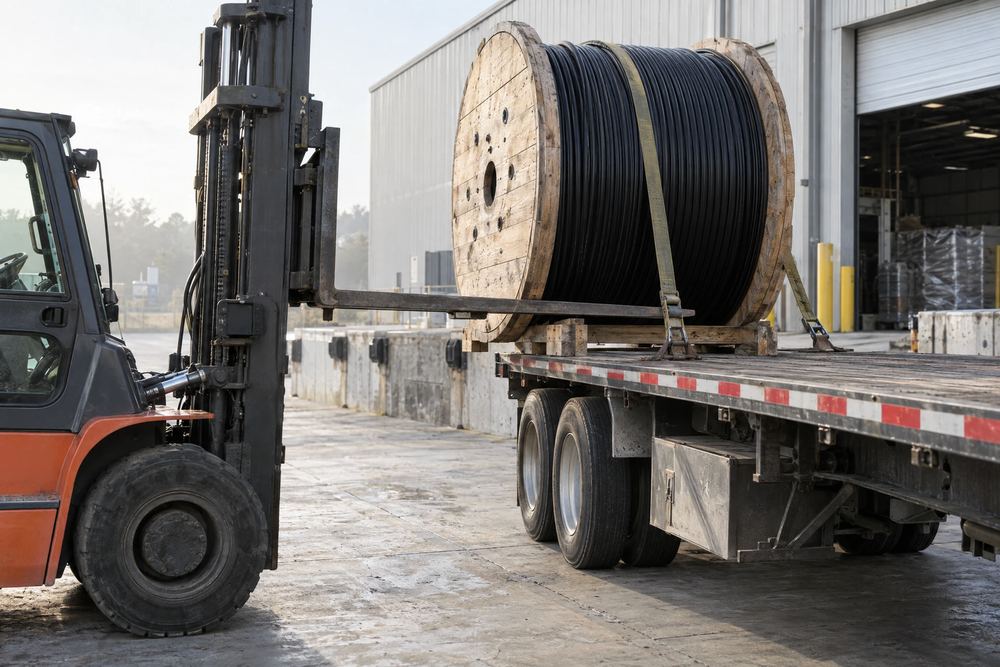
Weight adds up fast. A 250 foot coil of 12-2 MC is heavy enough that one person should not carry it far, and a pallet of coils is a dock and forklift job. LTL works for palletized coils, while a van trailer or flatbed is easier for reels. Two people can move a small carton; nobody moves a pallet of 10-3 by hand. Much of what we see from North Dakota is short coil ends from commercial work in the east and plant maintenance in the west.
- Cartons with two or three coils inside
- Single coils with a taped or capped end
- Open coils with the armor kinked at the bend
- Reels of larger feeder MC
- Mixed sizes in one pallet, described as mixed
What to send with your request
- A photo of the print on the armor
- The cut end, showing the ground path
- Conductor count and size, for example 12-2
- Remaining length or the carton marking
- Whether the armor is kinked, crushed or opened
- Coil count and carton condition
- Any PVC jacket over the armor, and its print
Not sure it fits? Send it anyway. If the construction is something else entirely, we will say so and point you at the right category. Condition and partial footage do not disqualify a submission — they just become part of the conversation.
Request a purchase quote
Send the wire details. Get a real conversation.
Photos and a few specs are enough to start. We will come back with questions or pricing, then agree on pickup or shipping.
Common questions
MC and AC Cable questions
Is BX the same thing as AC cable?
BX is an old trade name that crews still use for armored cable. The modern product is Type AC, with a bonding strip in contact with the armor. If the assembly has a green insulated ground wire, it is MC rather than AC.
Can MC cable be installed in a wet location?
Only when the specific assembly is listed for it, which usually means a PVC jacket over the armor and a marking that says so. The conductors inside being THWN does not make the whole cable wet rated.
Do you buy short coil ends?
Yes. Coils of 40 or 60 feet are common and worth listing. Give the approximate remaining length, the size and count, and a photo of the end so the condition is clear.
Reels sitting in the yard?
Send the tag and a photo of the jacket legend. We will tell you what we need to make an offer.