Wire category
WE BUY SURPLUS TRAY CABLE AND VFD CABLE
Tray cable earns its keep by not needing conduit, and that is exactly why leftovers pile up. A contractor buys 1000 feet for a tray run, uses 640, and the rest sits on a wooden reel in the yard. We buy those reels, along with the VFD cable that came off the same project, which is a different animal at a different price.
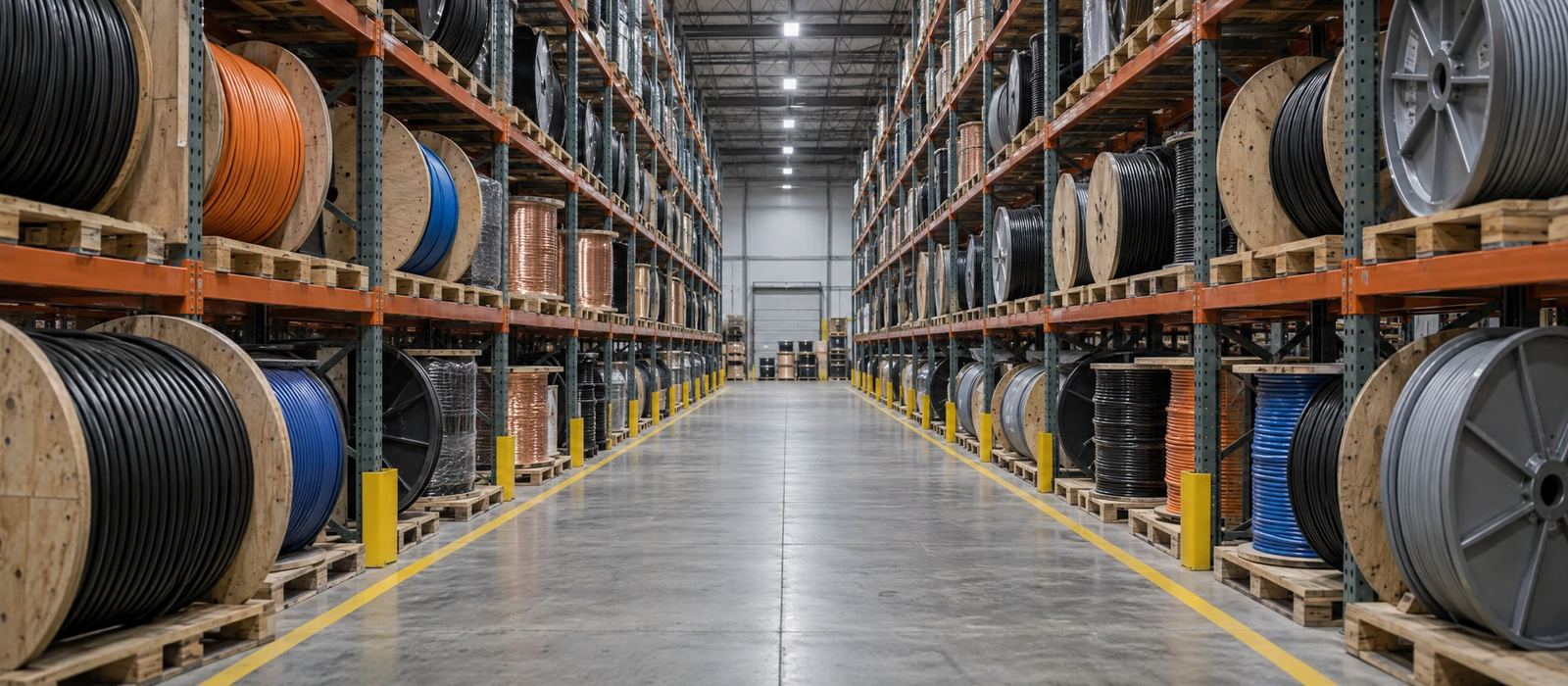
Tray Cable and VFD Cable · North Dakota
Surplus wire, reviewed from photosTC is a 600 volt multiconductor assembly, normally 90°C dry and 75°C wet, sunlight resistant, and direct buried only when the print says so. TC-ER adds the exposed run rating that lets it leave the tray without conduit. VFD cable is built for the output of a drive, with symmetrical grounds and a shield. Read the print before you describe it.
What we buy in this category
- Type TC multiconductor in 2 through 37 conductors
- TC-ER with the exposed run marking
- PLTC and ITC cable from control and instrument work
- VFD cable in 1kV and 2kV, shielded
- Continuous flex VFD cable for moving equipment
- Reels with the outer end still stapled to the flange
- Cut lengths with a known footage
- Partially used reels from plant projects
TC, TC-ER, PLTC and what the print says
Type TC is listed to UL 1277 and covered in Article 336. The print on the outer jacket gives the type, the conductor size and count, the voltage, the temperature, and usually whether it is sunlight resistant and direct burial rated. TC-ER will say ER, and that marking is what allows the exposed run between a tray and equipment. A reel marked TC only is not a substitute. The print repeats along the jacket, so a clean stretch is usually findable.
PLTC is a different product for power limited circuits at 300 volts, covered in Article 725, and it is not tray cable for a 480 volt feeder no matter how similar the jacket looks. Tray fill is governed by Article 392, which sets how much cable can sit in a ladder or wire mesh tray. None of that changes what we buy, but it changes the questions a buyer asks. Fill limits depend on the tray type and the conductor sizes, and they get checked at inspection.
VFD cable is not tray cable with a shield
A drive output cable is specified for three things: shield coverage, capacitance, and symmetry. The three phase conductors are laid up with three symmetrical ground conductors, then a foil or bronze braid shield, then a rugged jacket. Ratings of 1kV and 2kV are common because drive outputs carry fast switching transients that a 600 volt insulation system was never designed around. The shield needs a full 360 degree termination at both ends to do its job, which is a detail for the installer rather than the seller.
Corrosion and flex matter too. Jackets run from PVC to chlorinated polyethylene to thermoplastic elastomer, and flexible versions are rated for continuous flex at the drive end. Shield coverage is stated as a percentage. If the reel tag lists the shield type and the capacitance, photograph it, because that is what separates a usable reel from a heavy doorstop.
- Three conductor with three symmetrical grounds
- Foil shield with a tinned copper drain
- Bronze braid shield over foil
- 1kV and 2kV insulation systems
- PVC, CPE and TPE jackets
- Continuous flex constructions for drive duty
Reel condition and moving multi-conductor weight
Tray and VFD cable ship on wooden reels, 500 or 1000 feet is typical, with the footage on the tag and often printed on the jacket. Check that the outer end is stapled or taped to the flange rather than cut and dropped. Check the inner end as well, because a reel cut at both ends is a coil with a story. A reel rolled across a gravel yard will show jacket damage on the outer layer, and that layer is what the next job uses first.
Multi-conductor reels are heavy for their diameter and they roll. Band them, block them, and load with forks that reach the full width of the drum. LTL is possible on a pallet for small reels, but anything past a few hundred pounds goes better on a flatbed. Give the drum diameter if you can measure it, since it tells us what trailer to send. In North Dakota, tray cable reels tend to come out of plant and pipeline electrical work, where runs are long and the leftovers are large.
What to send with your request
- The full jacket print, including the type letters
- Whether ER appears on the print
- Conductor count, size and ground count
- Voltage and temperature rating from the print
- For VFD cable, the shield type and capacitance if tagged
- Footage on the tag and the remaining length
- Photos of both reel ends and the flange condition
- Reel weight or diameter if it is a large drum
Not sure it fits? Send it anyway. If the construction is something else entirely, we will say so and point you at the right category. Condition and partial footage do not disqualify a submission — they just become part of the conversation.
Request a purchase quote
Send the wire details. Get a real conversation.
Photos and a few specs are enough to start. We will come back with questions or pricing, then agree on pickup or shipping.
Common questions
Tray Cable and VFD Cable questions
What does TC-ER let you do that TC does not?
The ER marking is an exposed run rating. It allows the cable to leave a cable tray and run to equipment without conduit, within the limits of the installation article. A reel marked TC only does not carry that permission.
Is VFD cable priced like tray cable?
No. The shield, the symmetrical grounds and the 1kV or 2kV insulation make it a different construction and a different review. Send the reel tag so the shield type and voltage class are visible.
Do you buy a reel with 80 feet left?
Yes, and short reels are common on drive replacements. What matters is that both ends are accounted for and the print is readable, so the remaining length can be confirmed.
Reels sitting in the yard?
Send the tag and a photo of the jacket legend. We will tell you what we need to make an offer.