Wire category
WE BUY SURPLUS WELDING CABLE
Welding cable is bought by the foot and judged by the stranding. A lead dragged across a shop floor for a decade either has fine strands left or it does not, and the jacket tells the story. We buy leads, full reels, partial reels and the short jumpers that come off a machine when it gets moved across the shop. A lead coiled on a hook for years and one run over by a truck look different at the jacket.
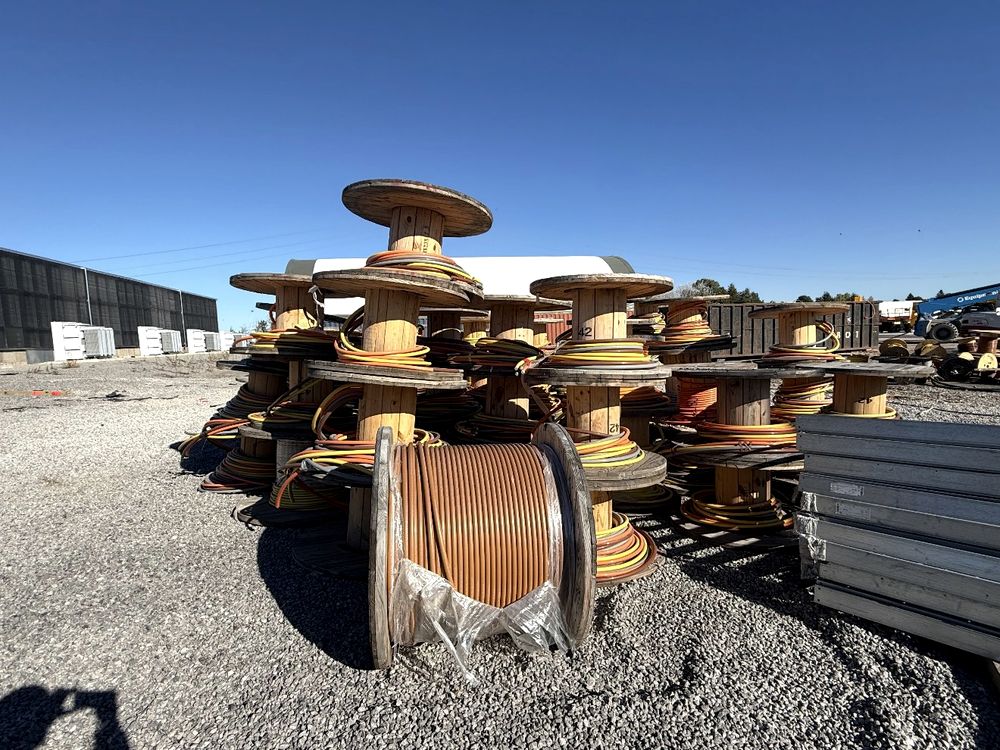
Welding Cable · North Dakota
Surplus wire, reviewed from photosThe standard product is 600 volt, 90°C, with a rope lay of very fine strands, usually around 30 to 34 AWG each, so the cable bends without work hardening. Sizes run from #6 up to 4/0. The jacket is a tough rubber or elastomer compound, oil resistant and sunlight resistant, usually red or black. Length and size together decide the voltage drop on a long run, which is why shops keep several sizes on hand.
What we buy in this category
- Welding cable in #6, #4, #2 and #1
- 1/0, 2/0, 3/0 and 4/0 leads
- Full 250 and 500 foot reels
- Partial reels with readable footage
- Short jumpers and stinger leads
- Leads with lugs or Cam lock connectors
- Cable with scuffed but continuous jackets
- Red and black cable in mixed lengths
Stranding is the whole point
A welding lead is not a power cable with a soft jacket. The conductor is rope stranded from hundreds or thousands of fine wires, which is what lets it flex at the stinger without breaking. A Class B building conductor of the same size has far fewer, larger strands and would fail in the same service within a season of steady work. Fine stranding is also why welding cable is reviewed on copper content with a smaller insulation allowance than building wire.
That is why the size and the strand count belong in a description. A #2 welding cable and a #2 THHN carry the same copper weight and are completely different products. If the print says 2/0 and the jacket marking is gone, the diameter and the flexibility are the next clues, and a close photo helps more than a guess. A lead with a lump under the jacket has probably been spliced, and a splice is worth mentioning before it is found.
- Rope lay conductor with fine strands throughout
- 600 volt insulation rated for flex
- Red and black jackets in the same lot
- Leads with lugs still attached
- Cable with a taped repair mid run
- Single conductor, no overall jacket
Jacket compounds and what kills them
Welding cable jackets are usually EPDM, neoprene or a thermoplastic elastomer, formulated for oil, ozone and abrasion. They handle hot slag better than PVC and stay flexible in the cold. What kills them is dragging, sharp edges and repeated bending at one point, usually right behind the stinger or at the machine lug. Heat damage shows as a hard, glossy patch, and it usually sits within a few feet of the stinger.
A jacket that is scuffed but continuous is still a usable cable. A jacket with a cut to the conductor, a hard flat spot, or a section gone stiff and checked is not, and no buyer wants to guess at it. Photograph the damaged area with something for scale and note the length of the good portion, because that is what gets reviewed. Tape wrapped over a jacket is not a repair anybody can evaluate, so unwrap it or photograph what is underneath.
Leads, reels and the lengths that matter
Welding cable moves in 25, 50 and 100 foot leads, in 250 and 500 foot reels, and in whatever lengths a shop has accumulated over the years. Reels are often steel or heavy wood, and a full 500 foot reel of 4/0 is a forklift item. Small leads bundle into a carton or a tote and ship with far less fuss. A drum dragged across concrete will have a split flange sooner or later, and a split flange is a loading problem before it is a cable problem.
Cut lengths are fine. What helps is the count and the range: six leads between 20 and 40 feet, plus one partial reel, is a description a buyer can work with. Fabrication shops and pipeline and oilfield service yards in North Dakota turn over welding cable when a machine is replaced or a lead fails inspection, and the cable often still has years left in it. Keep the leads coiled and tied separately, since a bundle of tangled leads takes an hour to sort and a tied coil takes a minute.
What to send with your request
- The size, for example 2/0, from the print or the tag
- The length of each lead or the footage on the reel
- Photos of both ends, including any lugs or connectors
- Any cuts, melt marks or hard flat spots in the jacket
- Jacket color and whether the print is still readable
- Lead count and the range of lengths
- Whether the cable is on a reel, a coil or loose
- How it is packed and how it can be loaded
Not sure it fits? Send it anyway. If the construction is something else entirely, we will say so and point you at the right category. Condition and partial footage do not disqualify a submission — they just become part of the conversation.
Request a purchase quote
Send the wire details. Get a real conversation.
Photos and a few specs are enough to start. We will come back with questions or pricing, then agree on pickup or shipping.
Common questions
Welding Cable questions
Does welding cable have a standard ampacity?
Not the way building wire does. What a lead can carry depends on the duty cycle of the machine and the length of the run. The reel tag and the jacket print give the size, and the size is where the review starts.
Do you buy leads with lugs and clamps still on?
Yes, and the connectors can stay. Say whether the ends are lugs, Cam locks or bare conductor, since a cleanly cut end is easier to inspect than one wrapped in tape.
Is welding cable ever used for temporary power?
It is a flexible single conductor and it gets used that way on some sites. The installation rules for temporary power are a separate question. We review the cable on size, stranding and jacket condition rather than on where it might be installed.
Reels sitting in the yard?
Send the tag and a photo of the jacket legend. We will tell you what we need to make an offer.