Industry
WIRE FROM PLANT MAINTENANCE AND DEMOLITION WORK
Taking a plant apart produces wire in every condition at once. Some of it never left the factory wrap. Some was pulled out of a tray and has the scars to show for it. Some sat in a boneyard for a decade. The material arrives mixed, and it has to be sorted before anyone can put a value on it. Sorting that pile is the whole job, and a description that separates the categories is worth more than a photo of a heap.
Plant Maintenance, Demolition and Decommissioning
North DakotaWhat comes down when a plant comes down
A demolition contractor pulls feeders from a rack, cuts conduit runs at the couplings and rolls tray cable off the tray. Most of it is copper from #12 up to 500 MCM, with a voltage class printed on the jacket that nobody reads until the material is on the ground and somebody has to describe it for a buyer. A rack pull usually means armored or tray cable, and both come down in long lengths.
Decommissioning a process area adds instrumentation and control cable, thermocouple extension, and shielded pairs pulled for a run that was never reused. Those are small cables with high value per pound, and in the right lengths the cable is worth more than the metal in it, so they deserve their own count and their own photographs.
New surplus versus pulled wire
The distinction matters and it is usually visible. Factory wrap and original banding say new surplus. A clean factory taper on the end says the reel was opened and part of it was used. A jacket that is chalky, abraded or bent at a hard radius says the cable already had a working life, and the bend is the part that matters most. Sun damage is not the same as abrasion, and the two price differently.
Be plain about it in the description. We are not looking for a story about the material, just an accurate one. If three reels are new and ten are pulled, say three and ten. If the ends are open and water got in, say that. Pricing follows the facts, and a clear description gets a faster answer than a hopeful one. Photographs of both ends beat one photo of the middle.
Handling reels in a demolition zone
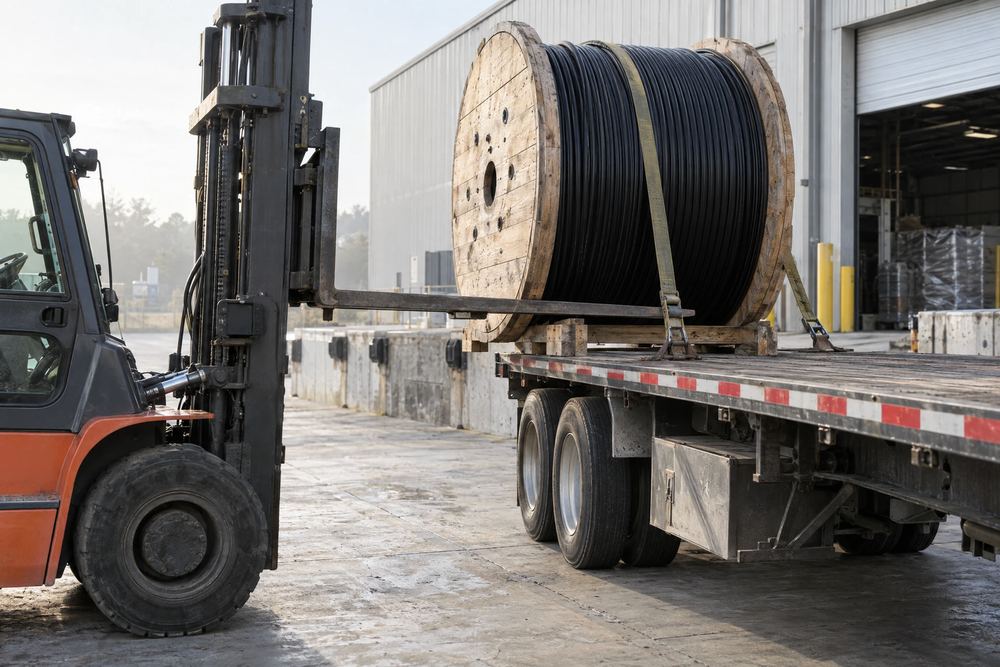
Demolition sites are hard on reels. A drum pushed by a track loader will not roll true, and a wooden reel that sat in a wet basement may not hold together for a lift. Banding rusts through and lagging pulls off the drum. A drum with a broken flange can still ship if it is cribbed and banded to a pallet. All of that affects how the load leaves the site and what equipment has to come with it.
Tell us what equipment is on hand. A site with an excavator and no forklift handles reels differently from a plant with an overhead crane. We can work with a flatbed, a van trailer, or a carrier that brings a lift gate for pallets of coils. Give the site address and the name of somebody who can open a gate, and the pickup gets planned around what the site can actually do.
Which wire and cable shows up
- Feeder copper from #12 to 500 MCM
- Tray cable pulled from cable tray
- Instrumentation and shielded pair cable
- Thermocouple extension wire
- THHN and XHHW from conduit runs
- Bare copper grounding and bus drops
- SOOW cord from temporary power
- Unused drums still in factory wrap
How surplus accumulates in this sector
- A plant teardown leaves tray cable rolled onto makeshift reels.
- A decommissioned process area gives up its instrumentation cable.
- A maintenance crew replaces a feeder and keeps the pulled length rather than cutting it up.
- A boneyard reel is found with the wrap still on it after years outdoors.
- A demolition contractor finishes a building and inherits the electrical leftovers.
- A line is idled rather than removed and the cable comes out all at once later.
This is not a customer list. These are potential seller audiences in North Dakota. No facility, contractor or company is described as having surplus inventory, and no relationship or endorsement is implied.
Request a purchase quote
Send the wire details. Get a real conversation.
Photos and a few specs are enough to start. We will come back with questions or pricing, then agree on pickup or shipping.
Clearing a storeroom or a laydown yard?
Send one wide photo of the pile and whatever tags you can read. We will work from there.